How word choice and grammar can indirectly impact the future of the planet.
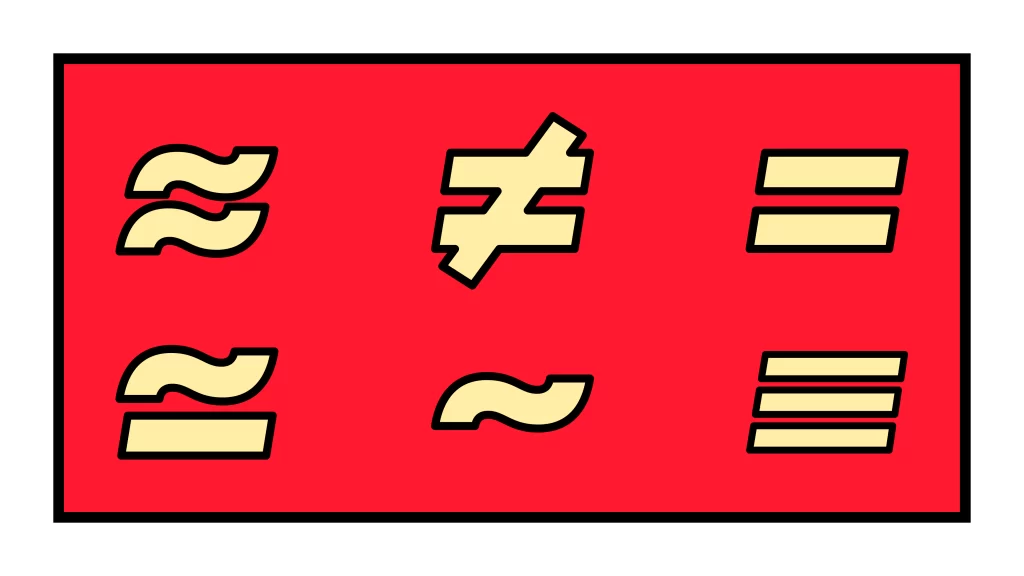
Approximate, not equal, equal, congruent, similar, and equivalent.
Identical to, not the same, the same, the same appearance but not equal, same shape but not the same, identical but not equal.
Each mathematical symbol illustrated in the figure above, and many more not represented, is part of the language of notation used to describe the relation of an object, concept, or idea concerning how equivalent they are in relation to one another and each other.
Scientists, mathematicians, and anyone who ventures into the field must distinguish the correct use and comprehension of these symbols to express the right mathematical ideas and concepts.
The same is accurate for using appropriate and precise language to describe, explain, and communicate concepts and ideas to another in written and spoken form. Recent studies have shown that in the last two decades, the general population has been losing vocabulary, a cause of preoccupation because it implies difficulty communicating and understanding messages. Adjacently, similar studies have also begun to demonstrate how vocabulary loss impacts human life on multiple scales, from the individual to the global point of view.
A good example is an excerpt of the book on the subject of energy policy, published in 2017 by Michael Child and Christian Breyer. When researching about the need for changes in the energy policies they found that depending on the individual understanding and use of the words transition and transformation the general population reacted differently to the expected outcomes of change.
Essentially, an internal representation of a concept provides an individual or group with a shared way “to interpret the environment, to reason and to make decisions”. Their findings conclude that open acknowledgment of worldviews that underlie different visions of change “is the elephant in the room of energy policy debates.
Michael Child and Christian Breyer
According to Child and Breyer ( 2017), the popular understanding of the word transition ascertains more importance to the process and the period of change.
Meanwhile, transformation indicates more importance to the magnitude, significance, and results of change. This definition is sustained by different dictionaries that have given similar definitions and meaning to both words: transition is the process of
change from one state or condition to another and transformation is a complete or major change in appearance and form.
Specifically in the context of energy policy, Child and Breyer (2017) have concluded that transition can be identified as a “passage from a well-known defined point of departure to a unitary and well-defined destination,” and transformation is a physical change in forms and systems. In addition, the same authors state that transformation is a narrower process inside of a broader process of transition rather than a different change process, altering the relationship between transformation and transition and allowing the broader concept to encompass the narrower. The scope scale is better understood when looked at from a socio-technical standpoint, because while transformation is directly related to the physical aspects of an organism or a system, transition is also concerned with how transformation and other change processes affect the social and technical aspects of larger and more complex systems.
Despite all that, the authors have demonstrated that different authors, both in and out of the energy field, have used the words in overlapping, interchangeable, and contradictory ways. The result of this semantic and linguistic confusion is a general misunderstanding of the scale and magnitude of what to expect emotionally, physically, and socially from the changes related to energy policies and the consequences can be unpredictable, as either the severity of the problem being communicated is over-escalated and causes resistance or de-escalated and is dismissed as unimportant.
In conclusion, throughout their work Child and Breyer (2017) have established the need for precise use of vocabulary, semantics, and grammar, because
Words, grammar, organizational structures, etc. can shape societal values, attitudes, and behaviors by framing issues and problems in a certain respect to highlighting various levels of problem recognition, the degree of change needed, underlying actions needed, and obstacles along the path of change. These linguistic factors represent a discourse, or “a shared way of apprehending the world.
Michael Child and Christian Breyer
Ultimately, they highlight the essential value of accurate use and comprehension of words, symbols, and language by the population in general, but especially among writers, scientists, and decision-makers.
Fonte:
Child, Michael, Breyer, Christian, 2017. Transition and transformation: a review of the concept of change in the progress towards future sustainable energy systems. Energy Pol. 107, 11–26.
https://doi.org/10.1016/j.enpol.2017.04.022.